
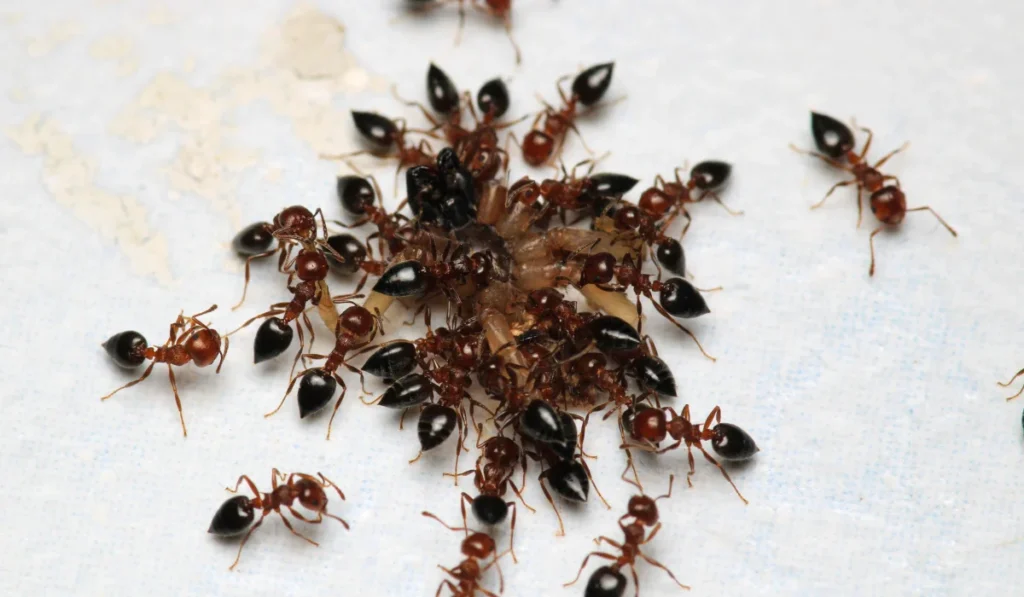
 You spot ants along your baseboards or walking across your counter, and the first question is simple: What kind of ants are these? Many Alabama homeowners struggle to distinguish household ants from carpenter ants because several species of ants look similar at first glance.
This difference matters. Some ants are a minor nuisance associated with food or moisture. Other ants can nest in walls or rotting wood, which can damage your home’s wooden components over time. When people misidentify ants, they often delay treatment, giving the colony time to grow.
This guide explains how to tell household ants from carpenter ants, why people often confuse them, the risks each type brings, and when to call a pest control company for ant control in Alabama.
You spot ants along your baseboards or walking across your counter, and the first question is simple: What kind of ants are these? Many Alabama homeowners struggle to distinguish household ants from carpenter ants because several species of ants look similar at first glance.
This difference matters. Some ants are a minor nuisance associated with food or moisture. Other ants can nest in walls or rotting wood, which can damage your home’s wooden components over time. When people misidentify ants, they often delay treatment, giving the colony time to grow.
This guide explains how to tell household ants from carpenter ants, why people often confuse them, the risks each type brings, and when to call a pest control company for ant control in Alabama.
Key Takeaways
Field Guide · Alabama
Household ants vs carpenter ants
Several ant species look similar at first glance. Size and nesting habits are key clues.
1Structural risk
Carpenter Ants
IDLarge, black or dark brown with an uneven, rounded thorax and elbowed antennae.
WhereDecaying wood, wall voids, crawl spaces, and older framing.
NoteThey tunnel through wood and can weaken structures over time. Sawdust indoors is a warning sign.
2Nuisance
Household Ants
IDSmall to medium with a smooth thorax, elbowed antennae, and consistent coloring.
WhereSoil, mulch, and wall voids; enter through small cracks.
NoteMostly a nuisance near food and moisture. Fire ants are an exception with painful stings outdoors.
Waynes has protected Southeast families for 50 years as an EPA Pesticide Environmental Stewardship member. Every little thing matters. A LOT.
- Carpenter ants are much larger than most household ants and are usually black or dark brown.
- Not all black ants are carpenter ants, but their size and nesting habits are key clues.
- Sawdust or small wood shavings inside your home often point to carpenter ants.
- A local ant exterminator can identify the ant species and recommend the appropriate control plan for your ant problem.
Video Guide: How To Identify Common Ants In Alabama Homes
This video highlights the most common ant species found in and around homes, showing differences in size, color, and behavior. Because many species look similar at first glance, seeing them side by side helps explain why household ants and carpenter ants are often mistaken for each other. Visual guidance makes it easier to match what you see at home with the signs covered in this article.What’s The Difference Between Household Ants And Carpenter Ants In Alabama?
When comparing household ants and carpenter ants in Alabama, the main differences involve size, nesting sites, and risk level. Household ants include pavement ants, little black ants, odorous house ants, crazy ants, pharaoh ants, and Argentine ants. These ants are the most common ones found inside Alabama homes. Carpenter ants are larger and prefer nesting in damp or rotting wood, wall voids, and older framing, and they often share these conditions with wood-boring carpenter bees that tunnel into eaves. Black carpenter ants are the most common type in Alabama. They do not eat wood like termites, but they tunnel through it and can weaken wooden structures over time. Alabama’s warm, humid climate supports large colonies, and heavy rain often pushes ants indoors. Knowing how each type behaves helps narrow down identification.Comparison Table: Household Ants vs Carpenter Ants
| Feature | Household Ants | Carpenter Ants |
|---|---|---|
| Size | Small to medium | Large |
| Color | Black, brown, mixed | Black or dark brown |
| Thorax | Smooth | Uneven, rounded |
| Antennae | Elbowed | Elbowed |
| Nesting sites | Soil, mulch, wall voids | Decaying wood, wall voids |
| Wood debris | None | Sawdust or wood shavings |
| Risk level | Nuisance | Structural risk |