
 Finding a dark spider in your basement, garage, or near a window can immediately raise one question: Is it a black widow?
Black widows do occur in Ohio, but they are not the only spiders that can look black or nearly black. Ohio State University’s Common Spiders of Ohio field guide covers hundreds of spider species found throughout the state and shows how much their appearance, habitat, and behavior can vary.
That means color alone is not enough to identify the spider in front of you. Body shape, markings, texture, movement, web type, and where you found it provide much better clues.
Finding a dark spider in your basement, garage, or near a window can immediately raise one question: Is it a black widow?
Black widows do occur in Ohio, but they are not the only spiders that can look black or nearly black. Ohio State University’s Common Spiders of Ohio field guide covers hundreds of spider species found throughout the state and shows how much their appearance, habitat, and behavior can vary.
That means color alone is not enough to identify the spider in front of you. Body shape, markings, texture, movement, web type, and where you found it provide much better clues.
Common Black Spiders in Ohio That Are Not Black Widows
Field Guide · Ohio
Black spiders that aren’t black widows
A dark spider in the basement or garage raises one question fast. Body shape, texture, markings, and behavior tell you more than color alone ever will.
1Venomous
Black widow
IDRounded, bulbous abdomen, smooth and often glossy, with a red hourglass marking typically visible on the underside.
WhereRemains around sheltered, irregular tangled webs in protected locations.
NoteThe red marking may not be visible when the spider is standing normally, so avoid handling and confirm with a photograph instead.
2Low concern
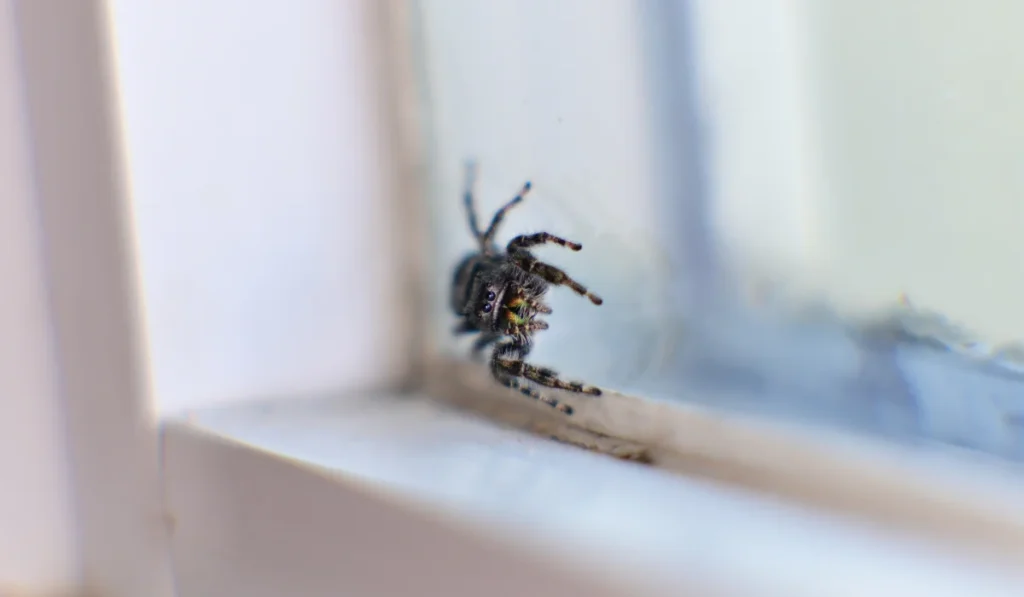
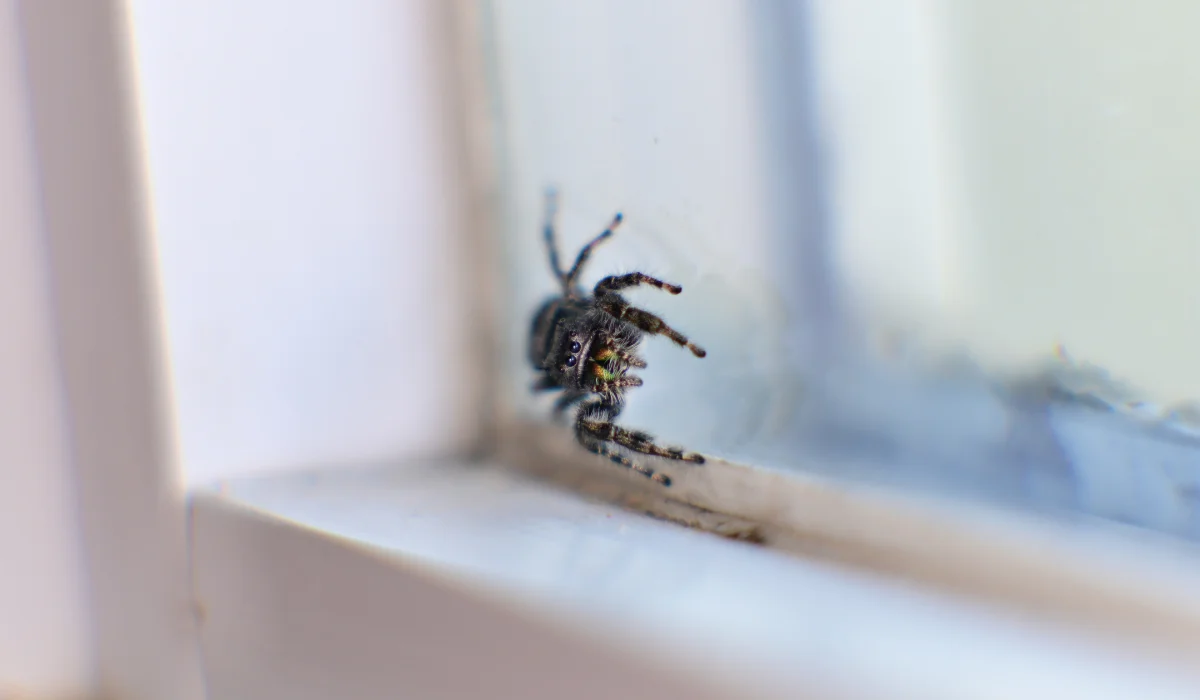
Bold jumping spider
IDCompact, noticeably fuzzy body, black or very dark with pale or white spots on the abdomen.
WhereWindows, siding, railings, and walls.
NoteActively hunts rather than waiting in a web. Its fuzzy texture is a useful clue against a mature female black widow.
3Low concern
Eastern parson spider
IDDark, elongated body with a pale stripe running along its back, longer and narrower than a black widow’s rounder abdomen.
WhereBasements, garages, storage areas, floors, walls, and baseboards.
NoteIts light stripe becomes less visible at night, when the spider can appear almost entirely black.
4Low concern
Black lace-weaver
IDVery dark body, often nearly black with lighter markings on the abdomen.
WhereFoundations, basements, and sheltered cracks and crevices.
NoteBuilds dense, irregular webbing in protected spots. Color alone shouldn’t be the deciding factor next to messy webbing.
5Low concern
Dark fishing spider
IDLarge, flat profile with long legs and mottled brown or gray coloring across the body and legs.
WhereExterior walls, wooded properties, and garages.
NoteCan look nearly black under poor lighting, but brighter light reveals the mottled pattern. Size does not indicate how dangerous a spider is.
6Low concern
Wolf spider
IDSturdy, hairy body in gray, brown, or a coloring that can look almost black indoors.
WhereBasements, garages, and landscaping.
NoteHunts on the ground rather than waiting in a prey-catching web. A photo with approximate size helps confirm identification.
Correct identification takes the guesswork out of a dark spider sighting. Every little thing matters. A LOT.
| Spider | Main Identification Clue | Typical Behavior | Where You May Find It |
| Bold jumping spider | Compact, fuzzy body with pale or white spots | Actively hunts and jumps | Windows, siding, railings, walls |
| Eastern parson spider | Dark, elongated body with a pale stripe | Runs quickly across surfaces | Basements, garages, storage areas |
| Black lace-weaver | Very dark body with lighter abdominal markings | Stays near irregular webbing | Foundations, basements, sheltered cracks |
| Dark fishing spider | Large, flat body with mottled coloring | Active hunter | Exterior walls, wooded areas, garages |
| Wolf spider | Sturdy, hairy body with brown, gray, or dark coloring | Hunts on the ground | Basements, garages, landscaping |
Bold Jumping Spider
The bold jumping spider, Phidippus audax, is one of the easier dark spiders to recognize once you get a clear view. It often has a black or very dark body with pale spots on the abdomen. Its body is compact and noticeably fuzzy rather than smooth and glossy. That texture is one useful clue that you are not looking at a typical mature female black widow. Bold jumping spiders also behave differently. Instead of waiting for prey in a large web, they actively hunt. You may notice one moving across siding, windows, railings, walls, or other surfaces where small insects gather. Their markings can be difficult to see from several feet away. Under poor lighting, a spider with obvious white spots may initially look completely black.Eastern Parson Spider
The eastern parson spider, Herpyllus ecclesiasticus, has a dark, elongated body with a pale stripe running along its back. It is a fast-moving hunting spider and may wander indoors along floors, walls, baseboards, or stored belongings. Homeowners often notice it at night when its light stripe is less visible and the spider appears almost entirely black. Body shape is particularly helpful here. The parson spider is longer and narrower than a mature female black widow, which typically has a much rounder abdomen.Black Lace-Weaver
The black lace-weaver, Amaurobius ferox, is another dark spider that can be encountered in Ohio. Adults may appear very dark brown or nearly black, often with lighter markings on the abdomen. Lace-weavers are associated with protected cracks and crevices where they construct dense, irregular webbing. Around buildings, this can include sheltered areas near foundations, basements, walls, and other undisturbed spaces. A quick look at a dark spider sitting near messy webbing can cause confusion, but color should not be the deciding factor. The spider’s markings, overall body shape, and the structure of the web provide more useful information.Dark Fishing Spider
The dark fishing spider, Dolomedes tenebrosus, is difficult to overlook because adults can become quite large. Despite appearing nearly black under poor lighting, these spiders are generally dark brown or gray with mottled markings across the body and legs. Under brighter light, those patterns become much easier to see. Dark fishing spiders also have long legs and a relatively flat profile. They are active hunters and can occur away from water, including around wooded properties, exterior walls, garages, and other sheltered structures. Size alone does not indicate how dangerous a spider is. A large spider is not automatically a greater medical concern than a smaller species.Wolf Spiders
Wolf spiders include many species, so there is considerable variation in their size and coloring. Some are gray or brown, while others can look almost black indoors. Most have sturdy, hairy bodies and spend their time hunting rather than waiting for insects in a prey-catching web. They frequently move across the ground and can occasionally wander into garages, basements, and other ground-level areas. If you are trying to identify a wolf spider, a photograph and approximate body size are more useful than simply describing it as black.How to Identify a Black Spider in Ohio
You usually cannot identify a spider reliably from one feature. Start with the characteristics you can observe safely. Do not pick up an unidentified spider or attempt to turn it over to inspect markings. A clear photograph taken from a safe distance often provides enough detail to compare its shape, surface, and visible patterns.| Identification Clue | What to Look For | Why It Helps |
| Body shape | Rounded, elongated, flat, or compact | A mature female black widow typically has a rounded abdomen |
| Body surface | Smooth, glossy, hairy, or dull | Hair and texture can point toward another spider group |
| Markings | Spots, stripes, mottling, or contrasting colors | Many lookalikes have markings that disappear in dim light |
| Movement | Jumping, running, or remaining near a web | Many dark lookalikes are active hunters |
| Web | Irregular tangle, dense webbing, or no capture web | Web type can provide useful identification context |
| Location | Basement, wall, garage, landscaping, foundation | Habitat can help narrow the possibilities |
Black Widow vs. Other Dark Spiders in Ohio
The red hourglass is the best-known black widow marking, but it should not be your only identification test. The familiar red marking is typically associated with the underside of the abdomen, so it may not be visible when the spider is standing normally. Immature spiders can also look different from mature females. A safer identification starts with the entire spider rather than trying to see its underside.| Feature | Mature Female Black Widow | Common Dark Lookalikes |
| Abdomen | Rounded and bulbous | May be elongated, flat, compact, or patterned |
| Body surface | Smooth and often glossy | May be hairy, dull, striped, or mottled |
| Markings | Red markings may be visible underneath | White spots, pale stripes, or brown and gray patterns may appear |
| Movement | Often remains around sheltered webbing | Many lookalikes actively hunt across surfaces |
| Web | Irregular tangled web in a protected location | May use another type of web or no prey-catching web |