

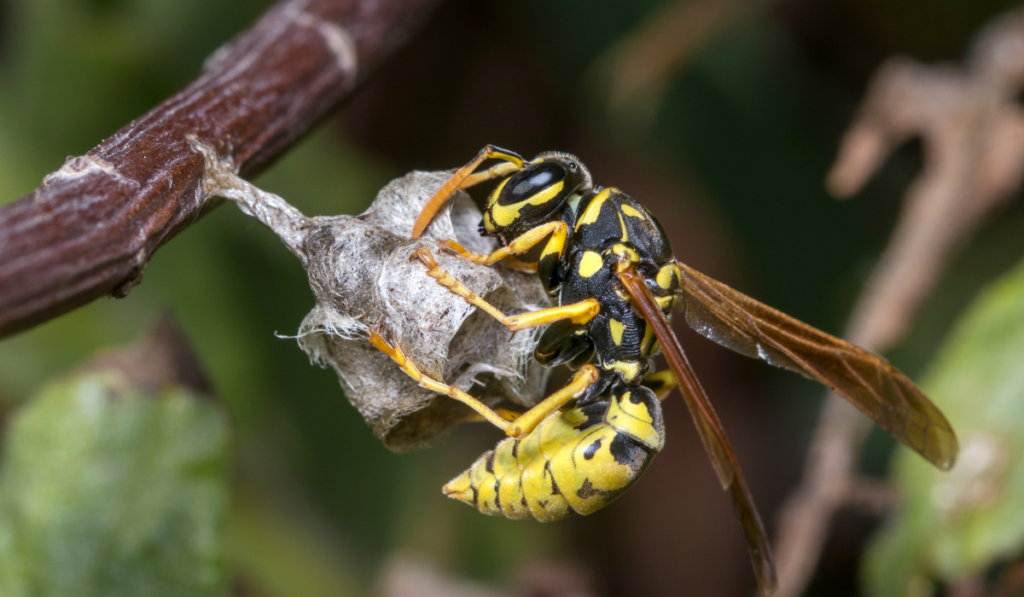
Alabama has six common wasp types, from paper wasps to yellowjackets. Learn which species nest near homes and when to call a pro.
Key Takeaways
- Six wasp species are most common in Alabama: paper wasps, yellowjackets, bald-faced hornets, European hornets, mud daubers, and cicada killers.
- Yellowjackets and bald-faced hornets are the most aggressive species and most likely to sting repeatedly when disturbed.
- Mud daubers and cicada killers rarely sting and actually reduce spider and cicada populations around your yard.
- Nest location tells you the species: paper nests under eaves, underground colonies, and mud tubes each point to a different wasp.
- Late summer and early fall are peak aggression periods, when colony sizes peak and food sources grow scarce.
Common Types of Wasps Found in Alabama Homes
Alabama hosts multiple wasp species, and not all of them pose the same threat to your home or family. Some species build nests in eaves and shrubs close to your doors. Others nest underground or pack mud tubes onto your walls. Knowing which wasp you are looking at determines whether you need professional help or can simply steer clear.
The six species you will encounter most often in Alabama are paper wasps, yellowjackets, bald-faced hornets, European hornets, mud daubers, and cicada killers. Each has distinct coloring, nesting behavior, and aggression levels. A quick visual check can tell you a lot before you take any action.
How Wasps in Alabama Build Nests and Behave
Most wasps in Alabama are social insects that build colonies around a single queen. Workers spend the season gathering food, expanding the nest, and protecting larvae. The colony grows steadily from spring through summer, reaching peak size by late summer. That population pressure is why wasp encounters feel more dangerous in August and September than in May.
Wasps build nests from plant and wood fibers they chew into a greyish paper material, or from mud depending on the species. Paper wasps produce the open, umbrella-shaped nests you often spot under eaves and overhangs. Yellowjackets enclose their nests completely and frequently tuck them underground or inside walls. European hornets hollow out hollow trees but will also occupy wall voids inside older structures.
Most female wasps can sting repeatedly, unlike honey bees, which lose their stinger on the first strike. That difference matters when you are dealing with an aggressive species near a high-traffic area of your yard. Workers also release an alarm pheromone signal when they feel threatened, which recruits other members of the colony to defend the nest. Disturbing a nest accidentally, even briefly, can trigger a coordinated response.
According to the Alabama Cooperative Extension System, wasps are most active during warm months and begin declining as temperatures drop in late fall, when colonies die off and only fertilized queens survive to start new colonies the following spring.
Paper Wasps and Yellowjackets in Alabama Yards
How Paper Wasps Nest Near Alabama Homes
Paper wasps are the slender, long-legged wasps you most often see flying slowly around your porch or roofline. They are reddish brown to dark brown with yellow markings and build the open, umbrella-shaped nests attached under eaves, inside gutters, and on the undersides of deck boards. Northern paper wasps and red paper wasps are both present across Alabama, and their nests look nearly identical to the untrained eye.
Paper wasp nests are small relative to yellowjacket colonies, typically housing 20 to 75 workers at peak season. These wasps feed larvae by capturing caterpillars and other insects, which makes them incidental garden allies. They will sting if you reach near the nest, but they do not patrol aggressively like yellowjackets. Give the nest space and they rarely bother you.
Why Yellowjackets Are the Most Aggressive Wasps in Alabama
Yellowjackets are compact, bright yellow and black insects that most people mistake for bees. Eastern yellowjackets are the dominant species in Alabama, though southern yellowjackets also appear across the state. Unlike paper wasps, yellowjackets build enclosed nests, often underground, in wall voids, or inside hollow logs, with colonies that can hold several thousand workers by late summer.
Yellowjackets are easily agitated and will sting repeatedly without provocation. They are scavengers as well as predators, which is why they show up at outdoor meals, trash cans, and open drink containers.
Competition for food supply intensifies in early fall as natural food sources decline, and that is when yellowjacket encounters become most frequent and most dangerous. Anyone with a known allergic reaction history should treat a yellowjacket nest as a medical risk, not a nuisance.
Nests inside walls or underground present a specific hazard because the entry point is not always obvious. Homeowners sometimes seal what looks like a small gap, trapping workers inside and forcing them to chew through drywall into the living space. If you hear buzzing inside a wall during summer, do not seal the opening before calling a pest control company.
Bald-Faced Hornets and European Hornets in Alabama
Where Bald-Faced Hornets Build Nests in Alabama
Bald-faced hornets are technically members of the yellowjacket family, though their black and white coloring sets them apart immediately. They build large, enclosed paper nests that hang from tree branches, shrubs, and the overhangs of structures. A mature nest can reach the size of a football or larger by August, with a population of 400 to 700 workers.
Bald-faced hornets are among the most aggressive wasp species in Alabama and will defend a wide perimeter around the nest. Research on bald-faced hornets confirms they use alarm pheromone signals to coordinate group defense, meaning a single disturbance can mobilize dozens of workers within seconds. Children and pets are at risk when a nest is located in a shrub or low tree at yard level. These nests require professional removal.
How European Hornets Differ from Other Wasps in Alabama
European hornets are the largest wasps you will encounter in Alabama, measuring up to an inch long with reddish-brown and yellow banding. They are active at night as well as during the day, which surprises homeowners who expect wasps to settle after dark. European hornets nest in hollow trees, wall voids, and attic spaces, often covering the nest with a papery envelope similar to bald-faced hornets.
European hornets feed on other insects but also damage trees and shrubs by stripping bark to access sap and plant fibers.
If you notice ragged bark damage on your ornamental trees in late summer, check for hornet activity nearby. Their nocturnal behavior means you may hear buzzing near porch lights without seeing the source until you trace it to a wall void or eave.
Night removal attempts are especially risky because the colony remains active.
Mud Daubers and Similar Insects in Alabama
Why Mud Daubers Pose Low Risk in Alabama Gardens
Mud daubers are solitary wasps that build small, cylindrical mud tubes on walls, under porches, and along foundation edges. They are slender, mostly black, and often show a thread-like waist that distinguishes them from social wasps. Each female builds her own nest, paralyzes spiders to provision the cells, and lays eggs inside before sealing them. There is no colony to defend.
Mud daubers rarely sting humans and actually reduce spider populations around your home, including black widows. The mud tubes look alarming, but the wasps themselves present minimal risk. You can remove old, inactive tubes with a putty knife and water. Active tubes, which feel heavier and show fresh mud, can be left alone in low-traffic areas or removed by a professional if they are inside a garage or shed where contact is likely.
Cicada Killers: Large but Low-Threat Wasps in Alabama
Cicada killers are the largest wasps in Alabama, sometimes exceeding an inch and a half in length, with yellow stripes and dark wings. They are ground-nesting, solitary wasps that dig burrows in sandy or bare soil, often along sidewalk edges, garden beds, and lawns. Despite their size and intimidating appearance, cicada killers are docile. Females focus on capturing cicadas to stock the burrow; males patrol but lack a stinger.
Cicada killers help control cicada populations, which reduces noise and tree damage in the late summer months. The main complaint is cosmetic: the burrows they dig can disturb lawn grass and garden beds. Improving soil coverage with mulch or dense planting discourages nesting. If populations grow large enough to create visible yard damage, a pest control company can treat the area without targeting the broader insect population in your yard.
When to Call a Pro for Wasp Problems in Alabama
Not every wasp encounter requires professional treatment. A single mud dauber tube or a small paper wasp nest on a fence post away from foot traffic can often be managed with a commercial wasp spray applied after dark, when wasps are inactive. Keep your distance, wear long sleeves and eye protection, and retreat after applying.
Call a pest control company when the nest belongs to yellowjackets or bald-faced hornets, when the nest is inside a wall or attic, or when anyone in your household has a history of severe allergic reactions to stings. These situations carry real medical and structural risk that outweighs any DIY savings. A professional can identify the species, locate hidden entry points, and apply a targeted treatment to the colony without scattering workers into living areas.
Waynes technicians follow an integrated pest management protocol: they inspect your property first to identify the species and all entry points, develop a customized control plan, then apply targeted treatment to the colony site. That approach protects other insects in your yard, including pollinators, while controlling the wasp population.
For wasp problems, that means inspecting first, confirming the species and nest location, then treating the colony site directly rather than spraying the entire exterior. That approach protects other insects in your yard, including pollinators, while controlling the wasp population.
Prevent wasps from returning by removing food sources before they attract a new colony each spring. Seal garbage cans, cover outdoor pet food, and repair any gaps or openings in soffits, eaves, and siding before April. Early spring is when queens scout nesting sites, so blocking access before the season starts is far easier than treating an established nest in August.
According to the EPA’s integrated pest management guidelines, combining structural exclusion with targeted treatments reduces the likelihood of reinfestation compared to reactive treatment alone. For Alabama homeowners, that means combining a spring inspection with any needed exclusion work on the exterior of the home.
Bottom Line on Types of Wasps in Alabama
Alabama’s warm climate and long growing season support a wide range of wasp species, from the low-risk mud dauber to the highly aggressive yellowjacket and bald-faced hornet.
Identifying the species correctly before taking action protects you from unnecessary stings and helps you decide whether the situation warrants a professional.
Most solitary wasps, including mud daubers and cicada killers, are incidental benefits to your yard. Social species that build large colonies near your home are a different matter entirely.
If you find a nest inside your walls, under your eaves, or within reach of children and pets, contact Waynes for an inspection. With 50 years of experience and 150,000 families served across Alabama, Tennessee, Florida, and Mississippi, the Waynes team knows exactly what to look for and how to treat it. Every little thing matters. A LOT.
Frequently Asked Questions
What months are wasps most active in Alabama?
Wasps are active in Alabama from late March through October. Colony populations peak in late summer, typically July through September, when workers are most numerous and food sources begin to decline.
This is when yellowjackets and bald-faced hornets are most likely to sting. Colonies die off in late fall, leaving only fertilized queens to overwinter and start new colonies the following spring.
How can I tell paper wasps apart from yellowjackets in Alabama?
Paper wasps are slender with long, dangling legs and build open, umbrella-shaped nests. Yellowjackets are stockier, bright yellow and black, and build enclosed nests, often underground or inside wall voids. Paper wasps fly slowly and hover near the nest. Yellowjackets move faster and forage aggressively around food and garbage. If you are unsure, note the nest shape and location before approaching.
Are bald-faced hornets common in Alabama?
Yes. Bald-faced hornets are widespread across Alabama, particularly in wooded suburban areas where mature trees and dense shrubs provide nesting sites. Their large, grey paper nests are most visible in fall after leaves drop. The nests appear inactive in winter, but the location often attracts new queens the following spring. Remove nests in winter when they are empty to discourage re-use of the site.
When should I call pest control instead of treating wasps myself?
Call a pest control company when the nest is inside a wall, ceiling, or attic space; when the species is yellowjackets or bald-faced hornets; when the nest is larger than a baseball; or when anyone in your home has a history of allergic reactions to stings. DIY treatments on large, aggressive colonies often scatter workers and increase sting risk without eliminating the colony. A professional can treat the colony directly and confirm it is controlled.
How do I prevent wasps from nesting on my Alabama property?
Seal gaps in soffits, eaves, and siding before April, when queens scout nesting sites. Keep garbage cans covered and remove fallen fruit promptly. Avoid leaving pet food outside overnight. Trim shrubs and trees away from the roofline, so wasps have fewer sheltered spots to attach nests. A spring exterior inspection by a pest control professional can identify vulnerable entry points before the season begins.


