
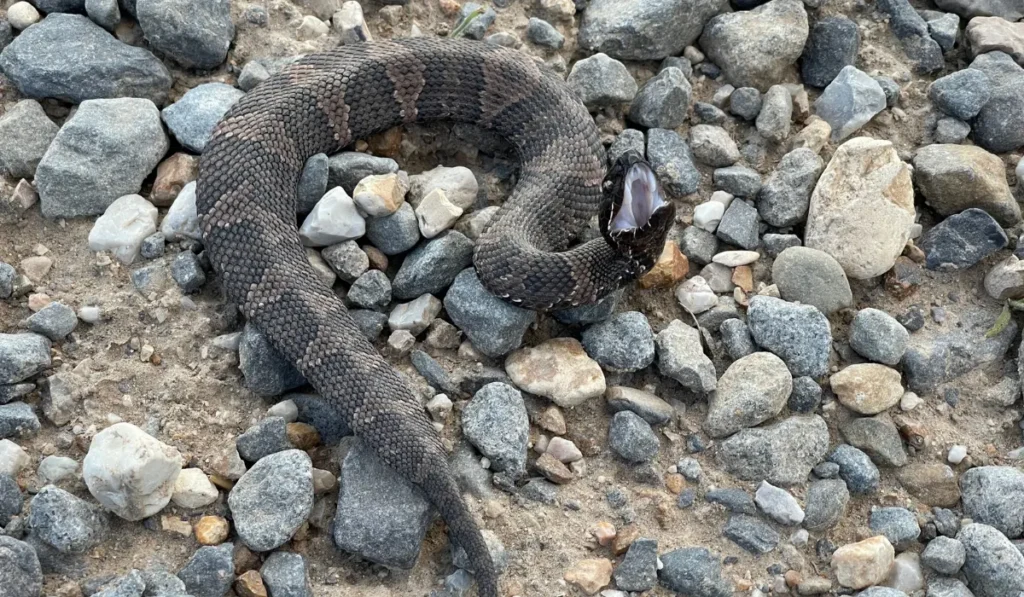
If you spot a dark, thick-bodied snake near a pond, creek, drainage ditch, or wooded edge, you may wonder whether it is a Panhandle cottonmouth. Cottonmouths are venomous, but several nonvenomous water snakes can look similar from a distance. The safest way to identify one is to compare several visible traits, including body shape, pattern, age, habitat, and behavior, without approaching the snake.
How to Identify a Panhandle Cottonmouth
A Panhandle cottonmouth is a heavy-bodied pit viper whose appearance can change with age and individual coloring. The Florida Museum of Natural History provides Florida snake-identification resources that emphasize looking at several characteristics together rather than relying on a single feature.
One of the cottonmouth’s best-known characteristics is the pale interior of its mouth. When threatened, the snake may gape and expose that light-colored lining. This defensive display is the source of the common name “cottonmouth,” but you should never approach or disturb a snake in an attempt to make it open its mouth.
Body Shape and Pattern
Cottonmouths generally have thick, heavy bodies. Dark crossbands may be visible along the body, although the pattern can become much harder to see on darker adults. Shadows, mud, vegetation, and distance can also make a patterned snake look nearly solid in color.
Because cottonmouths are pit vipers, they have heat-sensing facial pits. While those structures help distinguish pit vipers from many other snakes, they are too small to serve as a practical identification feature from a safe distance. If you need to move closer to inspect a snake’s face, stay where you are instead.
Head shape is also easy to overinterpret. A cottonmouth’s head can look broad compared with its neck, but some nonvenomous snakes flatten their heads when they feel threatened. A broad or triangular-looking head can be one clue, but it should never be your only reason for identifying a snake as venomous.
What Juvenile Cottonmouths Look Like
A juvenile cottonmouth can look noticeably different from the dark adult many people expect to see. Younger snakes generally show clearer, more contrasting body patterns, making their crossbands easier to notice.
Juveniles may also have a yellowish or greenish tail tip. Because their coloring changes as they mature, size and color alone are not dependable ways to decide whether a young snake is harmless.
When you encounter a smaller snake near water, use the same approach you would with an adult. Keep your distance and consider several visible characteristics rather than relying on one familiar-looking feature.
Panhandle Cottonmouth vs. Water Snake
Telling a Panhandle cottonmouth from a nonvenomous water snake is one of the most useful identification skills for Florida Panhandle homeowners. Both can occur around water, and either may be seen swimming, resting along a bank, or moving through vegetation.
Water snakes vary by species, so there is no single pattern or body color that separates every harmless water snake from a cottonmouth. A safer comparison looks at several traits together.
| Feature | Panhandle Cottonmouth | Nonvenomous Water Snake |
| Body | Usually thick and heavy-bodied | Build varies by species |
| Pattern | Crossbands may be clearer on younger snakes and less visible on darker adults | Markings vary by species |
| Facial pits | Present | Absent |
| Mouth display | May expose a pale mouth when threatened | Does not have the cottonmouth’s characteristic gape |
| Venom | Venomous | Nonvenomous |
Why Head Shape Can Mislead You
Head shape is often treated as a shortcut for separating venomous snakes from harmless ones. That shortcut can lead to mistakes because some nonvenomous snakes make their heads appear broader when they are threatened.
The cottonmouth’s white mouth presents a similar problem. Seeing a pale mouth during a defensive display can support an identification, but a cottonmouth may never gape during an encounter. The absence of that display does not rule the snake out.
The most useful features are the ones you can observe without moving toward the animal. If an identification clue requires a close look, it is not worth the added risk.
Why a Swimming Snake Is Not Automatically a Cottonmouth
“Water moccasin” is another common name for the cottonmouth, which can make it easy to assume that any snake swimming through a pond or creek is venomous. Nonvenomous water snakes also live in and around freshwater.
This matters around Florida Panhandle retention ponds, creeks, drainage channels, wetlands, and backyard water features. Seeing a snake in one of these places tells you something about where it is comfortable, but habitat alone does not confirm its identity.
If a snake is moving through the water or along the bank, give it room. Blocking its path or moving closer for a photograph creates unnecessary contact and may cause the snake to respond defensively.
Where Panhandle Cottonmouths Are Found
Panhandle cottonmouth habitat is closely associated with wetlands and waterways. Cottonmouths can occur around ponds, creeks, marshes, floodplains, drainage areas, and other wet environments found across the Florida Panhandle.
They are not restricted to the water itself. Cottonmouths can move across land, so homeowners may occasionally encounter one along a wooded edge, crossing a path, or moving through property near suitable wet habitat.
The Florida Fish and Wildlife Conservation Commission provides Florida-specific information about native snakes and wildlife. For homeowners, the location of an encounter can help determine how to respond. A snake beside an isolated pond can usually be given space, while one near a doorway, pet area, play space, or frequently used walkway requires more caution.
How Cottonmouths Behave Around People
Cottonmouth behavior can provide context, but it should not be treated as a stand-alone identification test. When threatened, a cottonmouth may remain still, coil, open its mouth, or move away. Not every individual will respond in the same way.
The open-mouth display is defensive. If a snake exposes the pale inside of its mouth, treat that as a warning to increase your distance rather than an opportunity to move closer for confirmation.
Avoid testing a snake’s response. Do not poke it, try to make it move, surround it, or stand between the snake and a route it could use to leave. Keeping your distance gives the animal space and keeps you out of unnecessary contact.
What to Do if You Find a Cottonmouth in Your Yard
If you believe you have a cottonmouth in your yard, move children and pets indoors or well away from the area. Do not attempt to catch, pin, pick up, or relocate the snake yourself.
If you can take a photograph without moving closer, use the zoom on your phone or camera. A clear image may help with identification later. Do not follow the snake into vegetation, reach beneath objects, or try to reposition it for a better view.
A snake near your house may simply be moving between nearby habitats. A creek, pond, wet drainage area, or wooded edge may explain why it crossed the property. If the snake remains somewhere people or pets cannot safely avoid, contact a qualified wildlife professional rather than attempting to remove it yourself.
What to Do After a Cottonmouth Bite
A suspected cottonmouth bite requires prompt medical attention. First, move away from the snake so another bite does not occur. Then seek emergency medical care. Do not attempt to catch or kill the snake for identification.
CDC and NIOSH venomous-snake guidance advises against several commonly suggested home remedies. Do not cut the bite, try to suck out venom, or apply ice. Do not use an improvised tourniquet unless a qualified medical professional specifically tells you to do so.
Poison Control can be reached in the United States at 1-800-222-1222. Follow emergency medical instructions and make treatment the priority. If you remember the snake’s general appearance from a safe distance, you can describe it to medical professionals without returning to the animal.
Reducing Snake Encounter Risks Around Your Property
Homes near ponds, creeks, wetlands, drainage corridors, or wooded areas may occasionally have snakes move through the property. Paying attention to places where you cannot clearly see the ground can reduce the chance of an unwanted close encounter.
Wear appropriate footwear when working around thick vegetation, wood piles, drainage areas, or other low-visibility spaces. Use a light when walking outside after dark, and look before placing your hands beneath boards, landscape materials, or objects that have been sitting undisturbed.
These habits are useful around many snakes, not just cottonmouths. If you notice a snake, giving it room is more useful than trying to force it out of sight or obtain an immediate identification.
Responding Safely to a Panhandle Cottonmouth
A Panhandle cottonmouth is best identified by considering several clues together, including its heavy build, crossband pattern, age-related appearance, habitat, and visible defensive behavior. A dark body, broad-looking head, swimming behavior, or open mouth can contribute to an identification, but none of those features should be used alone.
For Florida Panhandle homeowners, the safest response is to keep people and pets away, avoid handling the snake, and give it space to move on. If it remains close to your home or in an area you cannot safely avoid, professional guidance can help you decide what to do next.
Waynes helps homeowners throughout the region manage pest and wildlife concerns. You can review Waynes home services or contact Waynes about service availability for your Florida Panhandle property.